

Mostrando las entradas con la etiqueta esquiando [skiing]. Mostrar todas las entradas
Mostrando las entradas con la etiqueta esquiando [skiing]. Mostrar todas las entradas
jueves, 27 de julio de 2017

miércoles, 17 de mayo de 2017
Topos de esquí en Bariloche [ Bariloche's skiing topos]
Creo que ya les conté alguna vez que soy un poco fanático del esquí, desde aquella primera vez que mi padre me llevara a Las Leñas, Mendoza, hace unos 25 años, más o menos. Cuestión que muy lindo el centro de esquí, pero cuando descubrí esto del esquí de travesía, donde ahora no estás limitado a las pistas y sus alrededores, sino que podés esquiar donde te parezca, ahí sí que me hice fanático del todo, sobre todo porque también disfruto mucho de la parte de subir, y no solo de la bajada...
Así que cuando me vine a vivir a Bariloche, hice un par de cursos para aprender las cosas básicas de esquí de travesía y avalanchas, y ahora solamente quedaba salir a esquiar. Pero bueno, no es tan fácil, porque tenés que conseguirte algunos compañeros, y después hay que ver adónde vamos a esquiar. Y esta es la parte que no terminaba de entender al principio: ¿por dónde arrancamos? Una guía de esquí de travesía por la zona de Bariloche no habría estado mal, pero bueno, no existía en ese momento, y creo que sigue sin existir...
I think I've already told you that I really like skiing, since that first time I went to Las Leñas, Mendoza, with my father, something like 25 years ago. The ski center is very nice, but when I discovered ski mountaineering, where you are no longer limited to the ski pistes, you can ski wherever you want, I think at that point I became a ski fanatic, mainly because I also enjoy the way up, as much as the down.
So when I moved to Bariloche, I made a couple of courses to learn the basics about ski mountaineering and avalanches, and now it's just time to go out skiing. But well, it's not so easy, you need to find some partners, and then, where do we go skiing? And that was the part I couldn't yet understand: where we may start? A ski mountaineering guide around Bariloche would have been useful, but I think it didn't existed at that time, nor does now, to my knowledge....
Así que cuando me vine a vivir a Bariloche, hice un par de cursos para aprender las cosas básicas de esquí de travesía y avalanchas, y ahora solamente quedaba salir a esquiar. Pero bueno, no es tan fácil, porque tenés que conseguirte algunos compañeros, y después hay que ver adónde vamos a esquiar. Y esta es la parte que no terminaba de entender al principio: ¿por dónde arrancamos? Una guía de esquí de travesía por la zona de Bariloche no habría estado mal, pero bueno, no existía en ese momento, y creo que sigue sin existir...
I think I've already told you that I really like skiing, since that first time I went to Las Leñas, Mendoza, with my father, something like 25 years ago. The ski center is very nice, but when I discovered ski mountaineering, where you are no longer limited to the ski pistes, you can ski wherever you want, I think at that point I became a ski fanatic, mainly because I also enjoy the way up, as much as the down.
So when I moved to Bariloche, I made a couple of courses to learn the basics about ski mountaineering and avalanches, and now it's just time to go out skiing. But well, it's not so easy, you need to find some partners, and then, where do we go skiing? And that was the part I couldn't yet understand: where we may start? A ski mountaineering guide around Bariloche would have been useful, but I think it didn't existed at that time, nor does now, to my knowledge....
 |
| ¡Vamos a esquiar! Si, pero, ¿adónde? Lets go skiing! Yes, but, where to? |
domingo, 23 de abril de 2017
Digresión fotográfica #1 [Photo digression #1]
Introducción

El otro día se me ocurrió que quizás era buena idea poner una foto y contar un poco la historia que tiene atrás, en una especie de asociación libre de ideas, recuerdos, planes para el futuro, etc, que vayan surgiendo a partir de ahí. Así que vamos con el primer intento a ver qué sale.
Aunque, ahora que lo pienso, ¿esto no sería justamente "Instagram"? Puede
ser, pero no tengo una cuenta, ni teléfono inteligente, así que
tomemosló como una inspiración, oh, esa delgada línea entre el homenaje y
el plagio, pero bueno, no nos vayamos por las ramas, a lo que vinimos,
la foto:
Introduction
The other day I was thinking of posting a picture and tell the story behind it, something like a brainstorm, memories, plans for the future etc, anything it may came out in the process of writing it. So lets see what happens with the first try.
The other day I was thinking of posting a picture and tell the story behind it, something like a brainstorm, memories, plans for the future etc, anything it may came out in the process of writing it. So lets see what happens with the first try.
But wait, is not this the idea of "Instagram"? May be, but I don't have an account, nor a smart phone, so let's take it as an inspiration, oh, that thin line between homage and plagiarism, but wait, lets don't lose the thread, we where whit the photo:

martes, 18 de abril de 2017
Temporada de volcanes 2016 [Volcano season 2016]
El invierno pasado fue un tanto corto y caluroso acá por Bariloche: La nieve empezó a caer a mediados de Julio, para mitad de Octubre las temperaturas estaban bastante altas y la cantidad de nieve era similar a la de mitad de Noviembre del año anterior. En 2015, en cambio, estábamos esquiando a mitad de Junio... Todo esto hizo que en 2016 tuviéramos unos tres meses de esquí, contra unos cinco el año anterior.
Sin embargo, esta temporada tuve la suerte de esquiar algunos volcanes que tenía en la lista: Lonquimay, Llaima, Lanín y Tronador. Así que creo que es hora de una actualización de "esquiando los volcanes".
This
past winter was rather short and
hot here in Bariloche: Snow started falling about mid of July, by mid of
October the temperatures where rather hot, and the snow coverage
was similar (even less) than in mid of November the previous year. By
the
way, in 2015 we were skiing at beginning of June... All this meant than
in 2016 we have something like three months of skiing, when the
previous year it were about five months.
Anyway, this season I was lucky enough to go to some volcanoes I was hopping to ski: Lonquimay, Llaima, Lanín and Tronador. So, time for an update on skiing the volcanoes.
 |
| Volcanes al amanecer, desde la cara Este del Lanín. Cerro Peinetas en el medio (este no es un volcán, creo), Llaima al fondo a la izquierda, y el Lonquimay a la derecha, casi en el horizonte Volcanoes at dawn, from Lanín's East face. Peinetas hill in the middle (not exactly a volcano, I think), Llaima at the bottom left, and Lonquimay to the right, almost in the horizon |
 |
| Tierra de volcanes, de izquierda a derecha: Tolguaca, Sierra Velluda (al fondo), Callaqui, Lonquimay y Copahue Volcano land, from left to right: Tolguaca, Sierra Velluda (at the bottom), Callaqui, Lonquimay and Copahue |
 |
| Un poco de tráfico en el Lanín... (foto por Francisco) A little bit of traffic y Lanín... (photo by Francisco) |
 |
| Amaneciendo en Tronador, lástima la vista :-P Sunrise in Tronador, the view it's really a pity :-P |
jueves, 9 de febrero de 2017
Ski Frey
El refugio Frey es uno de los más famosos de Bariloche, Argentina. Está situado en las laderas del cerro Catedral, cerca del centro de esquí. Sus agujas de granito cerca del refugio se han convertido en un destino de escalada internacional, acá está la guía online de escalada, la página de Rolando Garibotti. El lugar es realmente hermoso, y en invierno hay un montón de laderas para esquiar.
Refugio Frey is probably the most famous hut near Bariloche, Argentina. It's situated in Catedral hills, near Cerro Catedral ski center. The granite "agujas" near the hut had become an international climbing destination, here is the online climbing guide, from Rolando's Garibotti page. The place is really beautiful, and in winter, there is a lot of terrain to go skiing.
Refugio Frey is probably the most famous hut near Bariloche, Argentina. It's situated in Catedral hills, near Cerro Catedral ski center. The granite "agujas" near the hut had become an international climbing destination, here is the online climbing guide, from Rolando's Garibotti page. The place is really beautiful, and in winter, there is a lot of terrain to go skiing.
 |
| Laguna Tonchek, el refugio Frey a la izquierda, aguja Frey al medio. Tonchek lagoon, Frey hut to the left, and aguja Frey at the middle. |
 |
| Otra vista de la laguna Tonchek, mirando al oeste desde el refugio (foto por Guido) Another view of Tonchek lagoon, looking west from the hut (photo by Guido) |
 |
| Escalando en la aguja Frey, al fondo se ve el refugio, a la derecha de la laguna Tonchek. Ah, perdón, estábamos hablando de esquiar... Climbing at aguja Frey, the hut is visible in the background, right of Tonchek's lagoon. Oh, sorry, we were talking about skiing... |
 |
| Nieve polvo en diciembre, eso no es muy usual... Esta fue mi primera vez en Frey, diciembre de 2010 Powder snow in December, that's not so usual... This was my first time in Frey, December 2010 |
jueves, 28 de enero de 2016
Esquiando los volcanes [Skiing the volcanos]
Siempre me gusto esquiar, desde la primera vez que me puse un par de esquíes hace más de veinte años. Pero yo vivía en La Pampa, así que mi mundo del esquí estaba limitado a algunos días al año en el centro de esquí de Las Leñas (Mendoza) y el Cerro Bayo (Villa La Angostura, Neuquén). A veces en Las Leñas veía los carteles de "peligro" al principio de alguna bajada fuera de pista, incluso llegué a esquiar algunas, pero nada demasiado alejado de las pistas.
Después me mudé a Bariloche (en 2010) y leí un artículo de Sebastián de la Cruz donde contaba que había esquiado desde la cumbre del monte Tronador, que en realidad es un volcán. En ese momento, me parecía imposible si quiera llegar a la cumbre del tronador, no tenía el equipo, ni el entrenamiento ni (lo más importante) las habilidades necesarias para subir hasta ahí, así que mucho menos para esquiar una pendiente de 45 grados.
Pero este artículo fue como una inspiración, mostrandme que las cosas que a veces parecen imposibles no lo son tanto. Esto no quiere decir que cualquiera puede ir a esquiar desde la cumbre del Tronador, es Sebastían de la Cruz el que está hablando acá...
De todas formas, la idea de esquiar desde la cumbre de los volcanes me quedó dando vueltas en la cabeza. Durante las siguientes temporadas de esquí, después de llegar a Bariloche, aprendí un poco sobre esquí de montaña, escalada en hielo y transito glaciar. También empecé a salir más seguido a las montañas, ya que me quedaban más cerca.
Finalmente el invierno pasado (2015) tuve el privilegio de poder esquiar algunos volcanes que venía mirando hace algunos años, entre ellos el Lanín y el Osorno. También esquié el Casablanca (todos desde la cumbre) y la mayor parte del Puntiagudo. Hay muchos volcanes cerca de Bariloche, así que la lista es casi infinita, acá elegí algunos, incluyendo algunos que esquié y otros que espero esquiar en el futuro: Lanín, Osorno, Casablanca / Grupo Antillanca, Tronador, Puntiagudo, Puyehue, Villarrica, Mocho / Choshuenco, Llaima y Lonquimay.
I've always likes skiing, since I first step on a pair of skis more than 20 years ago. But I used to live in the flat lands, so my skiing world was limited to the in bound area of Las Leñas (in Mendoza) and Cerro Bayo (in Villa La Angostura, Neuquén). Sometimes in Las Leñas I saw the "warning" signs at the beginning of some out of bounds run, I even took some of them, but nothing really far away from the pistes.
Después me mudé a Bariloche (en 2010) y leí un artículo de Sebastián de la Cruz donde contaba que había esquiado desde la cumbre del monte Tronador, que en realidad es un volcán. En ese momento, me parecía imposible si quiera llegar a la cumbre del tronador, no tenía el equipo, ni el entrenamiento ni (lo más importante) las habilidades necesarias para subir hasta ahí, así que mucho menos para esquiar una pendiente de 45 grados.
Pero este artículo fue como una inspiración, mostrandme que las cosas que a veces parecen imposibles no lo son tanto. Esto no quiere decir que cualquiera puede ir a esquiar desde la cumbre del Tronador, es Sebastían de la Cruz el que está hablando acá...
De todas formas, la idea de esquiar desde la cumbre de los volcanes me quedó dando vueltas en la cabeza. Durante las siguientes temporadas de esquí, después de llegar a Bariloche, aprendí un poco sobre esquí de montaña, escalada en hielo y transito glaciar. También empecé a salir más seguido a las montañas, ya que me quedaban más cerca.
Finalmente el invierno pasado (2015) tuve el privilegio de poder esquiar algunos volcanes que venía mirando hace algunos años, entre ellos el Lanín y el Osorno. También esquié el Casablanca (todos desde la cumbre) y la mayor parte del Puntiagudo. Hay muchos volcanes cerca de Bariloche, así que la lista es casi infinita, acá elegí algunos, incluyendo algunos que esquié y otros que espero esquiar en el futuro: Lanín, Osorno, Casablanca / Grupo Antillanca, Tronador, Puntiagudo, Puyehue, Villarrica, Mocho / Choshuenco, Llaima y Lonquimay.
 |
| Viendo qué se puede esquiar en el volcán Puntiagudo, con Martín y el Pájaro Hopping to get some skiing in Puntiagudo volcano, with Martín and Pájaro |
I've always likes skiing, since I first step on a pair of skis more than 20 years ago. But I used to live in the flat lands, so my skiing world was limited to the in bound area of Las Leñas (in Mendoza) and Cerro Bayo (in Villa La Angostura, Neuquén). Sometimes in Las Leñas I saw the "warning" signs at the beginning of some out of bounds run, I even took some of them, but nothing really far away from the pistes.
Then I moved to Bariloche (in 2010) and I read an article of Sebastián de La Cruz who
skied from the top of Mount Tronador, which in fact is a volcano. At
that time, it seemed really far away for me just to step on top of
Tronador highest peak, I didn't had the equipment, training nor (most
important) the skills to get up there, never mind skiing down a 45
degree slope.
But this article sparked my imagination, showing that things that look impossible aren't so. This doesn't mean than anyone could go and ski Tronador, it's Sebastian de la Cruz here who is talking...
Nevertheless, the idea of skiing from atop of volcanos stayed in my mind. During the following ski seasons, after arriving to Bariloche, I learned about ski mountaineering, ice climbing and glacier travel. I also started to go out to the mountains more often, since they where closer.
But this article sparked my imagination, showing that things that look impossible aren't so. This doesn't mean than anyone could go and ski Tronador, it's Sebastian de la Cruz here who is talking...
Nevertheless, the idea of skiing from atop of volcanos stayed in my mind. During the following ski seasons, after arriving to Bariloche, I learned about ski mountaineering, ice climbing and glacier travel. I also started to go out to the mountains more often, since they where closer.
Finally
this past winter (2015) I had the privilege to ski some volcanos I had
been watching since some years ago, namely Lanín and Osorno. I also
skied Casablanca volcano (all of them from the top) and most part of
Puntiagudo. There are a lot of volcanos near Bariloche, so the list is
almost endless, I've picked some of them, including some ones I've
skied and some others I'm hopping to do so: Lanín, Osorno, Casablanca /
Antillanca group, Tronador, Puntiagudo, Puyehue, Villarrica, Mocho /
Choshuenco, Llaima and Lonquimay.
miércoles, 12 de agosto de 2015
Buscando algo de nieve [Searching for some snow]
Parece que el invierno está llegando, cayó algo de nieve a fin de mayo y principio de junio, no demasiado, pero mejor que nada... La idea es esquiar un poco antes de julio, porque me voy de viaje a Perú por cuatro semanas, y creo que voy a extrañar un poco el esquí...
Este año el clima viene parecido al invierno pasado: caen algunas nevadas seguidas por un aumento de la temperatura, así que el manto de nieve está bastante fino, y tenemos nieve primavera a fin del otoño.
A fin de mayo cayó una nevada, y no pudimos resistir la tentación de ir a ver cuánta nieve había en el cerro Tronador, cerca del refugio Meiling. Este es el pico más alto de la zona de Bariloche. El manto de nieve era fino pero igual pudimos hacer algunas bajadas, y un poco de escalada en hielo en las grietas del glaciar.
It seems that winter is coming, some
snow has fall down here at the end of May and beginning of June, not too
much, but better than nothing... The idea is to get some skiing before
July, because I'll be travelling to Perú for four weeks, so I think I'll be missing a bit the skiing...
The
weather this year has a similar behavior than last year: some snow
storms followed by a rise in temperature, so we tend to have a thin
snowpack with spring snow conditions in late autumn.
At
end of May a storm left some snow, we couldn't resist the temptation to
get a look at the snow slopes up in cerro Tronador, near Meiling hut.
This is the highest peak around Bariloche. The snowpack was thin but we
managed to get some turns, and some ice climbing in the crevasses.
 |
| ¿Habrá algo de nieve che? Would there be some snow? |
 |
| Y, es fin de mayo, ¿que esperabas? La vista vale la pena, de todas formas Well, its end of May, what did you expected? Anyway, the view is amazing |
viernes, 23 de enero de 2015
Invierno 2014 [Winter 2014]
Bueno, la idea era escribir un poco durante el invierno sobre esquí de travesía en Bariloche, pero (como siempre) no tuve tiempo. Así que mejor escribo todo junto, algo así como un resumen del invierno pasado.
Well, the idea was to make some
blog post during the winter about skiing around Bariloche, but (as
usual) I didn't have the time. So I thought about putting it all
together in one post, something like a summary of this past winter.
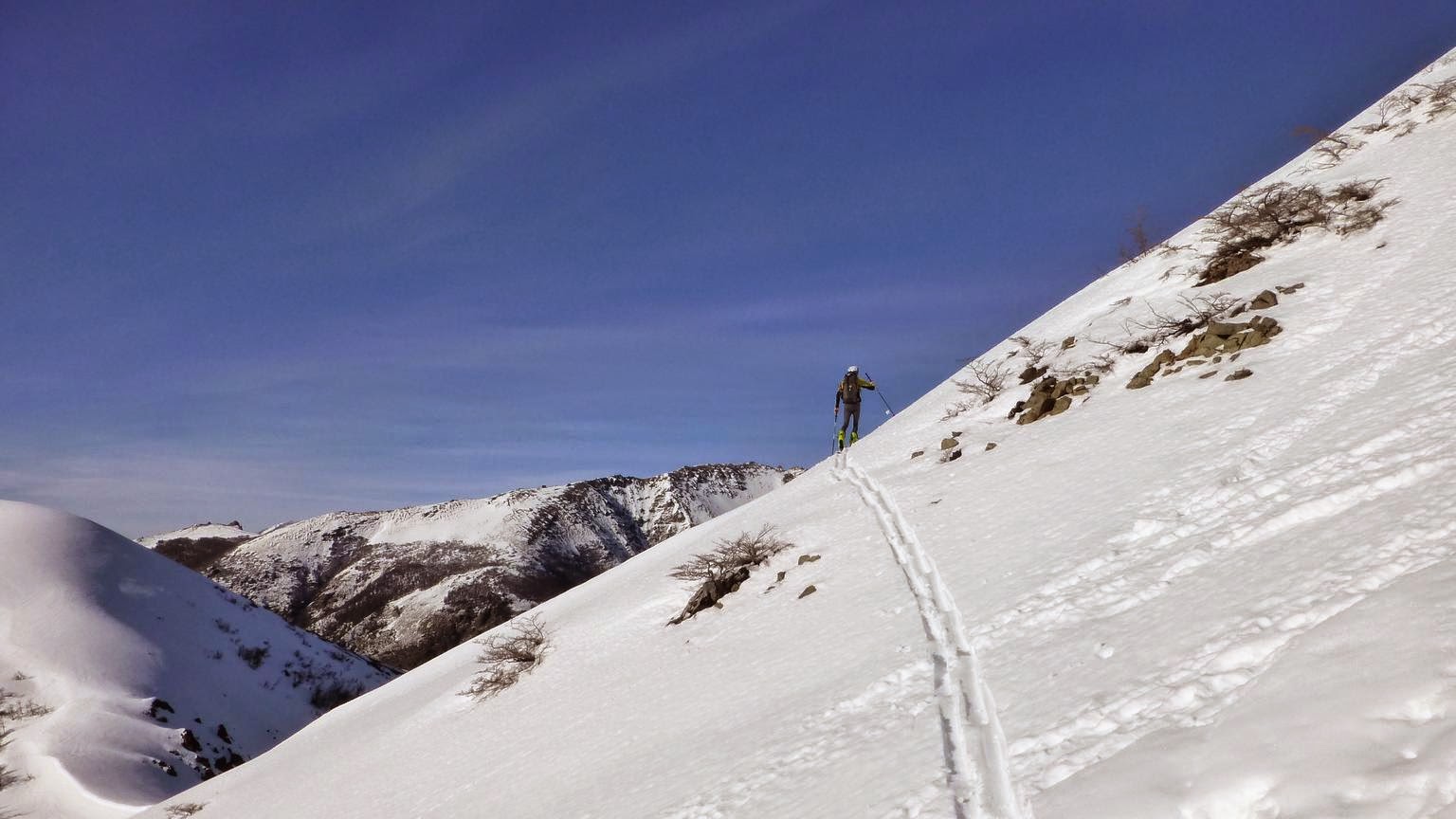 |
| Buscando un poco de nieve, cerca del cerro Bella Vista. Searching for some snow, near Bella Vista hill. |
martes, 22 de julio de 2014
Encerando los esquíes [Waxing your skis]
Hace algunos años escuché que era necesario encerar los esquies para que esquien mejor. Creía que no era tan importante, hasta que un día fui a esquiar con unos “lápices” que compró mi papá hace unos veinte años más o menos, hacía unos diez años que no veían un poco de cera. Así que tratar de deslizar con esos esquies no era fácil, lo cual complicaba iniciar los giros, o tratar de controlar los esquíes de alguna forma. Así que me pareció que era buena idea darle una oportunidad a la cera antes de echarle la culpa a los esquíes por mi falta de habilidad en las pistas. Resultó ser que los esquies anduvieron mucho mejor después de encerarlos, incluso podía controlarlos adentro de la pista (fuera de pista ya era otra historia, pero ahí era culpa del esquiador, no del equipo).
Some time ago I heard that you needed to wax your skis so they will ski better. I used to thought that it wasn’t so important, until I go out skiing with a couple of “sticks” my father bought about twenty years earlier, they hadn’t seen wax in the last ten years maybe. So, trying to slide with those skis wasn’t easy, that make it difficult to initiate a turn, or to control the skis in any way. So I thought I may give the wax a try before blaming the old skis for my lack of ski abilities.
Some time ago I heard that you needed to wax your skis so they will ski better. I used to thought that it wasn’t so important, until I go out skiing with a couple of “sticks” my father bought about twenty years earlier, they hadn’t seen wax in the last ten years maybe. So, trying to slide with those skis wasn’t easy, that make it difficult to initiate a turn, or to control the skis in any way. So I thought I may give the wax a try before blaming the old skis for my lack of ski abilities.
It
turned out that these old skis skied much better after waxing them, I
could even control them inside the groomed slopes (off piste was another
story, but thats the rider’s fault, nothing to blame to the gear).
lunes, 7 de julio de 2014
Esquiando un poco [Getting some skiing]
Bueno, me parece que estoy escribiendo demasiado… Van algunas fotos esquiando por la zona de Bariloche y alrededores, de las temporadas 2012 y 2013, espero que les gusten...
Well, I think I’m writing too much… Here are some skiing pictures near Bariloche, from season 2012 and 2013, I hope you enjoy…
 |
| Cerro Catedral, Bariloche, antes de que abra la temporada. Una vista un tanto inusual, comparado con la temporada alta: Casi no hay gente, pistas sin pisar, nieve virgen (y piedras), no se escucha música, y no se mueven los medios de elevación. Cerro Catedral, Bariloche, before the season starts. Kind of unusual view, compared with high season: Almost no people, ungroomed slopes, wild snow (and rocks), no music, and no lifts moving. |
 |
| Subiendo al cerro Challhuaco, Bariloche, con Ana, Santiago y Matias (de izquierda a derecha). La cumbre se ve arriba a la derecha. Esto fue después de dos días de una tormenta de nieve húmeda, así que la nieve estaba pegoteada por todos lados. Vimos varios árboles caídos culpa de esta tormenta (otra razón para no ir a esquiar los dias de tormenta). Heading up to Challhuaco hill, Bariloche, with Ana, Santiago and Matias (from left to right). The summit can be seen at the top right of the photo. This was after two days of a wet snow storm, snow was sticking to everithyng. We saw a lot of trees recently fallen down (another reason not to ski on storm days). |
 |
| Cumbre del Challhuaco: Santiago, Matías, Ana y yo, de izquierda a derecha. Muchas montañas para explorar al fondo, mirando hacia el sur. El cerro Carreras es uno de los más altos de la zona, con cerca de 2400 m de elevación (está en algún lado en la foto, ahí de fondo), altura similar al cerro Siete Colores (también por ahí al fondo) y cerro Catedral (no salen en la foto). Tronador es el pico más alto de la zona con unos 3490 m. Challhuaco summit: Santiago, Matías, Ana and me, from left to right. A lot of hils to explore looking south, Carreras hill is one of the highest of the zone, about 2400 m of elevation (it is somewhere there in the background), similar height than Siete Colores hill (also there in the background) and Catedral hill (not seen in the picture). Tronador is the highest peak of the region with about 3490 m. |
martes, 1 de julio de 2014
¿Esquí de travesía? ¿Qué es eso? [ Backcountry Skiing? what’s that? ]
Había escuchado hablar del Esquí Alpino y del Esquí Nórdico, incluso del Telemark, ¿pero qué es esto del Esquí de Travesía? Eso fue lo que pensé la primera vez que escuché hablar de este deporte. Era el invierno (en el hemisferio sur) de 2010 y un amigo estaba comentado sobre un curso que estaba haciendo con el Club Andino Bariloche. Ahí me explicó que la idea era subir a la montaña por tus propios medios, sin usar la telesilla o cualquier otro medio de elevación. Una vez arriba, bajás esquiando como en el esquí alpino.
Entonces, la siguiente pregunta fue ¿Y cómo subís una pendiente con los esquíes puestos? ¿de costado, tipo escalera? Eso ya lo probé y no es de lo más cómodo… Bueno, en realidad la idea es usar una especie de alfombra sintética (pieles) que se “pega” a la base del esquí, esto permite que el esquí deslice hacia adelante pero se bloquee cuando quiere deslizar hacia atrás, y también se usa una fijación especial que te permite liberar el talón de la bota, permitiendo que pivote en la punta. Y listo, te pones las botas, pegas las pieles al esquí y empezas a patinar para arriba por la pendiente. Una vez arriba, “despegas” las pieles, ajustás el talón de la bota (¡y las botas!) y esquiás para abajo en el estilo que más te guste.
La idea parecía interesante, tenía que probarlo...
I’ve heard about Alpine Skiing and Nordic Skiing, even about Telemark, but what is Backcountry Skiing? Those were my thoughts the first time I heard about this sport. It was the winter (south hemisphere) of 2010 and a friend was talking about a course he was taking in with Club Andino Bariloche. So he explained me that the idea was to go up the mountain by your own means, without using the chairlift or other mechanical aid. Once you were up, you skied down like in alpine skiing.
So, the next question was "and how do you go up a slope with your skis on?" sidestepping? that would be too tiring, walking? I’ve tried that and is not very enjoyable… Well, no, the idea is to use a synthetic fur ("skins") you “paste” to the bottom of the skis, which allows the ski to slide forward but not backwards, and you also use a special binding which can free the heel of the boot so that it pivots in the toe. And you are done, you put on your boots, paste the skins to the skis and start sliding up the slope. Once at the top, “unglue” the skins, lock the heel (and the boots!) and ski down in your preferred style.
The idea looked interesting, I needed to try it...
 |
| Probando esto del Esquí de Travesía, parece que va bien eh (foto por Martín). Trying out Backcountry Skiing, it looks good eh (photo by Martín). |
Suscribirse a:
Entradas (Atom)